24×7 ICU and Critical Care Hospital in Hyderabad: What Patients and Families Should Know
When someone you love suddenly becomes seriously ill, every minute feels long. Families often have to make fast decisions about where to go and what to ask. Knowing a little about intensive care beforehand can make those moments less overwhelming.
An Intensive Care Unit (ICU) is a specially equipped part of a hospital for patients with life-threatening conditions. These patients need constant monitoring and, often, support for vital functions such as breathing, blood pressure, or kidney function. Critical care is the branch of medicine that looks after them, with doctors, nurses, and other specialists working as a team.
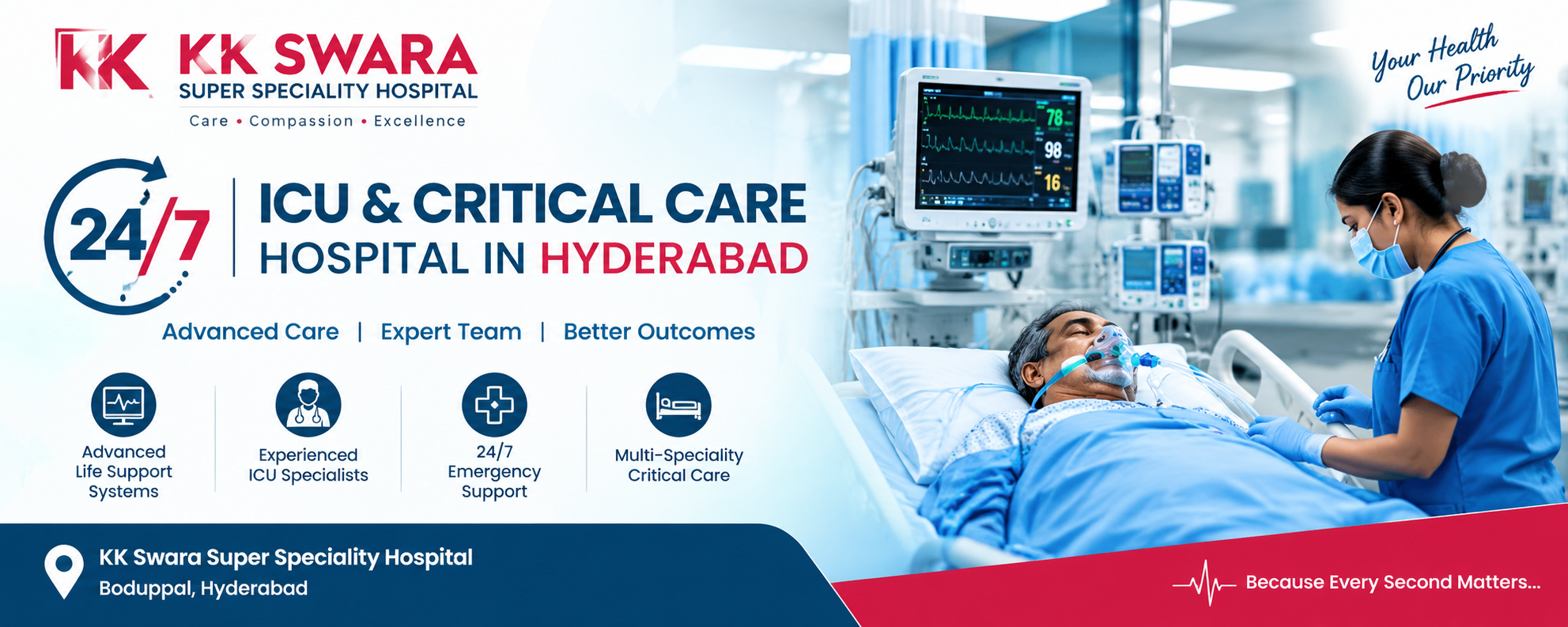
Emergencies do not follow office hours. A stroke, heart-related emergency, severe infection, or serious accident can happen at 3 a.m. That is why many families search for a 24×7 ICU and critical care hospital in Hyderabad, a hospital where assessment, monitoring, and emergency support are available around the clock. Timely assessment and continuous monitoring can make a real difference to how a patient is managed.
For residents of Boduppal and nearby areas, having a reliable hospital close to home matters. KK Swara Hospital (KK Swara Healthcare) in Boduppal, Hyderabad, is one local healthcare option. Facilities and availability can change, so we recommend confirming current ICU and emergency services directly with the hospital. This article is educational and does not replace medical advice. If someone has life-threatening symptoms, call an ambulance (108 or 112) now instead of researching online.
What Is an ICU and Critical Care Unit?
An ICU (Intensive Care Unit) is a specialized hospital unit that provides close, continuous monitoring and advanced life support for patients with serious or life-threatening conditions.
Critical care medicine is the field that manages these patients. It focuses on stabilizing the patient, supporting failing organs, and treating the underlying cause.
Key features of an ICU:
- Continuous monitoring: heart rate, blood pressure, oxygen level, and breathing are tracked constantly
- Organ support: equipment such as ventilators and infusion pumps can support breathing and circulation
- High staffing levels: more nursing attention per patient than in a general ward
- Rapid response: staff can act quickly if a patient’s condition changes
ICUs differ between hospitals in size, equipment, and capabilities. Some hospitals have separate units for adults, children, or heart patients.
Why 24×7 ICU Availability Is Important in Medical Emergencies
Round-the-clock ICU availability matters because critical illness can worsen at any hour, and many serious conditions are time-sensitive.
- Emergencies are unpredictable: Strokes, heart attacks, severe infections, and accidents occur day and night
- Conditions can change quickly: A patient who seems stable may deteriorate and need immediate support
- Specialist teams need to be available: Monitoring is only useful if trained staff can respond
- Early treatment can matter: For some conditions, such as stroke or sepsis, treatment delays can affect outcomes
A hospital that is open all day is not the same as a hospital with a fully staffed ICU at all hours, so it is wise to ask about this directly. We cover how to check later in this article.
24×7 ICU and Critical Care Hospital in Hyderabad
When people search for a 24×7 ICU and critical care hospital in Hyderabad, they usually want fast emergency assessment, an ICU with proper monitoring, qualified staff at all hours, and clear communication with the family.
Hyderabad has many hospitals, from large corporate centers to smaller neighborhood hospitals. Accessibility matters in an emergency, especially in a busy city with heavy traffic. So the factors that matter most are:
- Accessibility: how easily the hospital can be reached from where you live
- Emergency response: how quickly a patient is assessed on arrival
- Appropriate clinical facilities: ICU, monitoring, laboratory, and imaging support
- Medical team coordination: how emergency doctors, intensivists, and specialists work together
- Transparent communication: clear updates for the family about the patient’s condition and costs
Many people search for the “best critical care hospital in Hyderabad.” In reality, the right hospital depends on the patient’s condition, how far away it is, and what services are available at that moment. No ranking can tell you that.
Families in Boduppal and nearby localities such as Uppal, Peerzadiguda, and Medipally may look for ICU facilities near Boduppal. KK Swara Hospital in Boduppal is one such local option. (Publishing note: describe its ICU, emergency services, and 24×7 availability only after confirming them with official hospital information.) Learn more about our emergency care and ICU and critical care services.
Conditions That May Require ICU Admission
ICU admission may be needed when a patient has a serious condition affecting breathing, circulation, the brain, or other vital organs, or needs close monitoring after major surgery.
Common situations include:
- Severe breathing problems or respiratory failure
- Stroke and other neurological emergencies
- Heart-related emergencies, such as a serious heart attack or dangerous heart rhythms
- Severe infections and sepsis
- Major trauma and accident-related injuries
- Complications after surgery, or close monitoring after major operations
- Severe poisoning or drug overdose
- Serious metabolic emergencies, such as very high blood sugar crises
Not every emergency needs ICU admission. Many emergencies are treated in the emergency department and a general ward. The treating medical team decides the right level of care after assessing the patient.
Conditions Requiring Critical Care: Quick Reference
Medical Condition | Possible Warning Signs | Why Urgent Assessment May Be Required | General Type of Hospital Care That May Be Needed |
Severe breathing difficulty | Struggling to breathe, blue lips, unable to speak full sentences | Oxygen levels may fall dangerously | Oxygen therapy, monitoring, sometimes ventilator support |
Suspected stroke | Face drooping, arm weakness, slurred speech, sudden confusion | Brain tissue can be injured quickly | Emergency assessment, brain imaging, neurological monitoring |
Heart-related emergency | Chest pressure or pain, pain spreading to arm or jaw, sweating, breathlessness | The heart muscle or rhythm may be at risk | Cardiac monitoring, emergency treatment, specialist care |
Severe infection or sepsis | High fever, confusion, rapid breathing, fast heartbeat, very low blood pressure | Infection can affect multiple organs | Early antibiotics, fluids, close monitoring, organ support |
Major injury or accident | Heavy bleeding, severe pain, loss of consciousness, head injury | Internal bleeding or organ injury may not be visible | Trauma assessment, imaging, surgery, intensive monitoring |
Complications after surgery | Severe pain, bleeding, breathing trouble, drop in blood pressure | Early complications need quick action | Post-surgical intensive care and monitoring |
Warning signs are not a substitute for professional medical assessment. Only a doctor can decide what level of care a patient needs.
Emergency and Critical Care Services Available in a Hospital
A hospital with strong emergency and critical care services usually offers a connected set of services, not just ICU beds. These may include:
- Emergency medical care: triage, quick assessment, and stabilization on arrival
- ICU and critical care: continuous monitoring and organ support
- Cardiac monitoring and cardiac care: for heart-related emergencies
- Stroke and neurological care: for brain and nerve emergencies
- Respiratory support: oxygen therapy and ventilators
- Trauma and accident care: for injuries
- Post-surgical intensive care: for patients recovering from major surgery
- Laboratory and imaging services: blood tests, X-ray, CT, and ultrasound
- Specialist consultations: cardiology, neurology, surgery, and others as needed
- Pharmacy and blood bank access: for urgent medicines and transfusions
Services differ from hospital to hospital. Ask which of these are available on-site, and at what hours.
Role of Doctors, Nurses, and Critical Care Specialists in the ICU
ICU care is a team effort. Doctors, nurses, and allied professionals work together around the clock.
- Intensivists or critical care specialists: doctors trained in managing life-threatening illness
- ICU nurses: monitor patients closely, give medicines, and notice early changes
- Emergency physicians: assess and stabilize patients when they arrive
- Specialist doctors: cardiologists, neurologists, surgeons, and others called in for specific problems
- Respiratory and physiotherapy staff: help with breathing support and early mobilization
- Pharmacists and dietitians: manage medicines and nutrition
- Laboratory and radiology teams: provide quick test results
This multidisciplinary approach helps ensure that someone is always watching and that decisions are shared. A key question for families is who is responsible for the patient overnight.
ICU Equipment and Patient Monitoring Systems
ICUs use specialized equipment to watch the body’s vital signs continuously and support failing organs.
- Bedside monitors: track heart rhythm, heart rate, blood pressure, oxygen saturation, breathing rate, and temperature, with alarms for sudden changes
- Ventilators: machines that help or take over breathing when a patient cannot breathe adequately
- Oxygen therapy equipment: delivers extra oxygen through nasal tubes, masks, or high-flow systems
- Infusion and syringe pumps: deliver medicines and fluids at exact rates
- Defibrillators and emergency equipment: for life-threatening heart rhythms
- Central lines and invasive monitoring: used in selected patients for precise measurements
- Dialysis support: available in some ICUs for kidney failure
Advances in monitoring, including better bedside systems and tele-ICU support in some hospitals, have improved how closely patients can be watched. Equipment alone doesn’t make an ICU good, though. Trained staff and clear protocols matter just as much.
Difference Between ICU, Emergency Care, and General Wards
The ICU provides the most intensive care, the emergency department provides first assessment and stabilization, and the general ward provides routine care for stable patients.
Feature | ICU | General Ward | Emergency Department | HDU (High Dependency Unit) |
Purpose | Intensive care for life-threatening illness | Routine care and recovery | Rapid assessment and stabilization | Step-down care between ICU and ward |
Level of monitoring | Continuous, close, often one-to-one or one-to-two nursing | Periodic checks | Continuous during assessment | Frequent, more than ward but less than ICU |
Type of patients | Critically ill, may need organ support | Stable patients | Anyone with an urgent problem | Patients needing close watching but not full ICU support |
Typical care | Ventilators, infusion pumps, constant observation | Medicines, nursing, recovery | Triage, tests, first treatment | Close monitoring, some organ support |
Facilities and admission criteria vary by hospital. Ask the hospital how its units are organized.
When Should You Take a Patient to the ICU?
You don’t decide on ICU admission yourself. In an emergency, go to an emergency department or call an ambulance (108 or 112), and the medical team decides whether ICU care is needed.
Call for emergency help immediately if a person has:
- Severe difficulty breathing
- Chest pain or pressure, especially with sweating or breathlessness
- Signs of a stroke: face drooping, arm weakness, or speech difficulty
- Unresponsiveness, fainting, or severe confusion
- A seizure that lasts more than five minutes, or repeated seizures
- Heavy bleeding or a major injury
- A high fever with confusion, fast breathing, or very low blood pressure
- Suspected poisoning or overdose
- A severe allergic reaction
Don’t wait to see if symptoms pass. Don’t drive someone yourself if an ambulance can reach you, because paramedics can begin care on the way. Stay calm and give the team the person’s age, symptoms, medical history, and medicines. These are general guidelines, not a diagnosis.
How to Choose the Right Critical Care Hospital in Hyderabad
Check emergency services, ICU staffing, monitoring facilities, infection control, and cost transparency, and confirm them directly with the hospital.
Consider these factors:
- Appropriate emergency services: Is emergency care really available at all hours?
- ICU infrastructure and monitoring: Does the ICU have continuous monitoring and ventilator support?
- Qualified medical professionals: Who covers the ICU at night and on weekends?
- Nursing and monitoring arrangements: How many nurses look after each patient?
- Infection prevention and hygiene: What are the hand-hygiene, cleaning, and visitor rules?
- Coordination between emergency and specialist teams: How quickly can specialists be called?
- Clear communication with families: How often will you receive updates?
- Transparent information about treatment and costs: Can the hospital give a clear estimate?
It is also worth asking whether the hospital holds national quality accreditation, such as NABH, and verifying it on the accrediting body’s website. Accreditation is one indicator, not a guarantee. Visit or call the hospital ahead of time, not when an emergency strikes. See our guide on how to choose a hospital.
Importance of Early Diagnosis and Timely Critical Care
Early diagnosis and timely critical care matter because many serious illnesses are easier to manage when treatment starts quickly.
Stroke, heart attack, sepsis, and severe injuries are all conditions where time can matter. Early assessment lets the team find the cause, start treatment, and watch for complications before they worsen. Continuous monitoring can pick up small changes, such as a falling oxygen level or blood pressure, that might otherwise go unnoticed.
Prompt care doesn’t guarantee a particular outcome. Every patient is different, and results depend on the illness, age, and other health problems. But delaying care to wait for symptoms to settle is rarely a good idea.
Critical Care in India: Statistics and Healthcare Insights
- ICU capacity (pandemic-era estimates, about 2020): One estimate put India at about 2.3 ICU beds per 100,000 people, compared with 29.2 in Germany and 12.9 in Canada. However, India has no public database of ICU beds, and these numbers are likely an underestimate, with other models suggesting nearly 95,000 ICU beds. (Source: review in PubMed Central.) nih
- Sepsis in ICUs: The Sepsis in India Prevalence Study, reported by The George Institute for Global Health, found that one in two ICU patients across India has sepsis. georgeinstitute
- Emergency demand from road accidents (2023): The Ministry of Road Transport and Highways reported 4,80,583 road accidents in 2023, with 1,72,890 deaths and 4,62,825 people injured. The report was released in August 2025. dtnext
- Technology trends: Better bedside monitoring, electronic records, and tele-ICU models in some hospitals are helping teams track patients more closely.
- Preparedness: Because emergencies are unpredictable, hospitals, ambulance services, and families all benefit from planning ahead.
These are national figures. We did not include Hyderabad-specific ICU bed counts, because reliable public data is not available. Verify each statistic against its source before publishing.
ICU Admission Process and What Families Should Know
ICU admission usually follows emergency assessment, a doctor’s decision, and family consent where possible.
What typically happens:
- Arrival and triage: The patient is assessed quickly, often in the emergency department
- Stabilization: Urgent treatment begins, such as oxygen, fluids, or medicines
- Doctor’s decision: The team decides if ICU care is needed
- Consent and paperwork: Family members are asked to consent and complete admission forms
- Transfer to the ICU: The patient is moved and connected to monitors
- Ongoing updates: The team shares progress at regular times
Practical tips for families:
- Carry ID, insurance details, previous medical records, and a list of current medicines
- Nominate one family member as the main contact
- Ask when and how updates will be given
- Follow visiting and hygiene rules, which protect patients from infection
- Ask for an estimate of costs and what is covered
- Ask what to expect and what the treatment plan is
Infection prevention is important in ICUs. Staff and visitors are usually asked to wash or sanitize their hands and may need to wear protective gear.
Factors Affecting ICU Treatment Costs in Hyderabad
ICU cost depends mainly on the patient’s condition, how long they stay, and what support they need. No fixed price applies to everyone.
Key factors:
- Type and severity of illness: More serious conditions generally need more resources
- Length of ICU stay: Costs usually accumulate daily
- Ventilator or other organ support: Ventilators, dialysis, and similar support add to the cost
- Investigations and laboratory tests: Blood tests, scans, and imaging
- Medicines and consumables: Including antibiotics, infusions, and disposables
- Specialist consultations: Visits by different specialists
- Nursing and monitoring requirements: Higher intensity means higher charges
- Hospital facilities and room category: Single, shared, or standard ICU rooms
Costs can change as a patient’s condition changes. We have not listed any prices here, because charges depend on the situation. Contact KK Swara Hospital directly for current pricing, what is included, and billing information. If you have health insurance, ask about room-rent limits, sub-limits, and cashless procedures at the start. See our guide to insurance and cashless treatment.
Common Myths About ICU and Critical Care
Myth: “ICU means the patient will not survive.”
ICU means a patient needs close monitoring and support. Many patients recover and leave the ICU, although outcomes depend on the illness.
Myth: “Once a patient is on a ventilator, they can never come off.”
A ventilator supports breathing while the body heals or the cause is treated. Many patients are weaned off, but this depends on the condition.
Myth: “Every emergency needs ICU admission.”
Many emergencies are managed in the emergency department or a ward. The team decides.
Myth: “More machines mean better care.”
Equipment helps, but trained staff, good protocols, and timely decisions matter just as much.
Myth: “ICU patients are always unconscious.”
Many ICU patients are awake, and some are sedated to keep them comfortable. It varies.
Myth: “Visitors can come in at any time.”
Visiting is usually limited to protect patients from infection and allow clinical care.
Why Choose KK Swara Hospital in Boduppal, Hyderabad?
KK Swara Hospital (KK Swara Healthcare) is a healthcare provider serving Boduppal and nearby areas of Hyderabad. For families, the useful question is not just “Which hospital?” but “Does this hospital have what we need right now?” The hospital can be assessed on the same factors listed above:
- Availability of appropriate emergency services
- ICU infrastructure and monitoring facilities
- Qualified medical professionals
- Nursing and patient-monitoring arrangements
- Infection prevention and hygiene protocols
- Coordination between emergency and specialist teams
- Clear communication with patients’ families
- Transparent information about treatment and costs
(Publishing note: describe KK Swara’s specific services, equipment, doctors, facilities, and 24×7 availability only when they are verified through official hospital information. Do not add claims such as “No. 1,” “100% recovery,” or guaranteed treatment.)
We encourage you to contact KK Swara Hospital to confirm current ICU availability, emergency services, and treatment information before you need them. You can contact us or learn more about our doctors.
How to Find a 24×7 ICU and Critical Care Hospital in Hyderabad
To find a 24×7 ICU and critical care hospital in Hyderabad, search for emergency hospitals near you, check each hospital’s official website, and call to confirm that the ICU and emergency services are open at all hours.
A practical checklist:
- Search by location: Use a map or search tool for “emergency hospital near me” or “ICU hospital near Boduppal”
- Read official information: Check the hospital’s website, but treat claims as something to confirm, not proof
- Call and ask: Is emergency care open 24 hours? Is the ICU staffed around the clock? Which specialists are on call?
- Ask about equipment and capabilities: ventilators, monitoring, laboratory, and imaging
- Check accreditation: Verify any quality accreditation on the accrediting body’s site
- Plan the route: Know how to reach the hospital from home and work
- Save emergency numbers: 108 (ambulance) and 112 (national emergency), plus the hospital’s number
- Keep documents ready: Medical records, ID, insurance, and a medicine list
Do this when you are not in a crisis. If it is a true emergency, call for help immediately.
Key Takeaways
- Be prepared: Emergencies don’t follow office hours, so knowing which hospital offers round-the-clock emergency and ICU care helps you act quickly.
- ICU’s purpose: An ICU provides continuous monitoring and organ support for seriously ill patients, but not every emergency needs ICU admission.
- Know the warning signs: Severe breathlessness, chest pain, stroke signs, heavy bleeding, major injury, or confusion with fever need urgent assessment. Call 108 or 112.
- Choose with care: Check emergency services, ICU staffing and monitoring, infection control, communication, and cost transparency, and confirm them directly.
- Verify before you need it: Contact KK Swara Hospital in Boduppal to confirm current ICU availability, emergency services, and relevant information.
Frequently Asked Questions
- What is a 24×7 ICU and critical care hospital?
It is a hospital with an intensive care unit and emergency services staffed around the clock for seriously ill or injured patients. It provides continuous monitoring and life support. Availability and capabilities differ between hospitals, so confirm details directly. - How do I find a critical care hospital in Hyderabad?
Search for emergency hospitals near your location, check official websites, and call to confirm ICU and emergency availability at all hours. Ask about staffing, equipment, and costs. Save emergency numbers 108 and 112 in advance. - When does a patient need ICU admission?
A patient may need ICU care when a serious condition affects breathing, circulation, or the brain, or when close monitoring and organ support are needed. Doctors decide after assessing the patient. Not every emergency requires the ICU. - What is the difference between ICU and emergency care?
Emergency care provides first assessment and stabilization for urgent problems. The ICU provides continuous, intensive monitoring and organ support for critically ill patients, often after emergency treatment. Many patients are treated in emergency and then moved to a ward or ICU. - Is ICU available 24 hours a day in every hospital?
No. Not every hospital has an ICU, and not every ICU is staffed round the clock in the same way. Always confirm ICU availability, staffing, and emergency services directly with the hospital before you rely on them. - What conditions may require ventilator support?
Ventilators may be used for severe breathing failure, such as serious pneumonia, severe asthma or COPD episodes, major injury, certain brain or nerve conditions, and during recovery from major surgery. The team decides based on the patient’s condition. - How much does ICU treatment cost in Hyderabad?
Costs vary with the illness, length of stay, organ support, tests, medicines, and room category. No single price applies to everyone. Ask the hospital for a current estimate and what it includes, and check your insurance. - What should I check before choosing an ICU hospital?
Check whether emergency care and ICU are available at all hours, who staffs the ICU, monitoring and ventilator facilities, infection-control practices, specialist access, communication with families, and cost transparency. - Where is KK Swara Hospital located?
KK Swara Hospital is in Boduppal, Hyderabad, Telangana. [ADD VERIFIED FULL ADDRESS AND LANDMARK]. Please confirm the address on the hospital’s official website or by phone before you travel. - How can I contact KK Swara Hospital for ICU or emergency care?
Contact the hospital directly to confirm current ICU availability and emergency services: [ADD VERIFIED PHONE NUMBER / EMERGENCY CONTACT / WEBSITE]. For life-threatening symptoms, call 108 or 112 immediately instead of waiting.
Conclusion
When serious illness or injury strikes, timely assessment and appropriate critical care matter. Knowing what an ICU does, which warning signs need urgent attention, and what to ask a hospital can help families respond calmly. A 24×7 ICU and critical care hospital in Hyderabad is one that can assess, monitor, and support patients at any hour, with qualified teams and clear communication. Not every emergency needs the ICU, so the treating team’s assessment guides the level of care.
Plan ahead where you can. Save emergency numbers, keep key documents ready, and confirm services before you need them. Hospitals differ in what they offer, so verify details directly.
If you live in Boduppal or nearby areas, we encourage you to contact KK Swara Hospital to confirm current ICU availability, emergency services, and relevant hospital information. And if you or someone near you has severe or life-threatening symptoms, call 108 or 112 right away and seek emergency care without delay.
This article is for general awareness only and is not a substitute for professional medical advice. Please consult a specialist at KK Swara Super Speciality Hospital for diagnosis and treatment.