Which ACL Graft Is Better? A Patient’s Guide to Choosing the Right Option
Introduction
The anterior cruciate ligament (ACL) is a strong band of tissue inside the knee that stops the shin bone from sliding forward and helps the knee stay stable when you twist or change direction. An ACL injury means the ligament has been stretched or torn, often during a sudden stop, pivot, or awkward landing in sports such as football, cricket, basketball, or badminton.
A torn ACL does not heal well on its own. When the knee keeps giving way, or when someone wants to return to pivoting sports or physically demanding work, surgeons may recommend ACL reconstruction. In this operation, the torn ligament is replaced with a graft, a piece of tendon that acts as a new ligament.
That brings patients to a common question: which ACL graft is better? You will find strong opinions online, but the honest answer is that no single graft is best for everyone. Each option has its own advantages and trade-offs, and the best choice depends on your age, activity, sport, knee condition, and goals.
This is why the decision should be personal, not based on internet comparisons alone. An experienced orthopedic or sports-medicine specialist can examine your knee, review your scans, and explain which graft fits you. This article explains the options in plain language. It is educational and does not replace medical advice.
What Is an ACL Graft?
An ACL graft is a piece of tissue, usually tendon, used to replace a torn anterior cruciate ligament during ACL reconstruction.
During surgery, the surgeon removes the damaged ligament remnants. Small tunnels are made in the thigh bone and shin bone, and the graft is passed through them and fixed in place. Over months, the graft gradually heals into the bone and matures, a process called incorporation.
Grafts fall into two groups:
- Autograft: tissue taken from your own body, such as the patellar tendon, hamstring tendons, or quadriceps tendon
- Allograft: tissue from a screened donor
Your choice of graft affects the surgery, early recovery, donor-site discomfort, and possibly long-term outcomes.
Which ACL Graft Is Better?
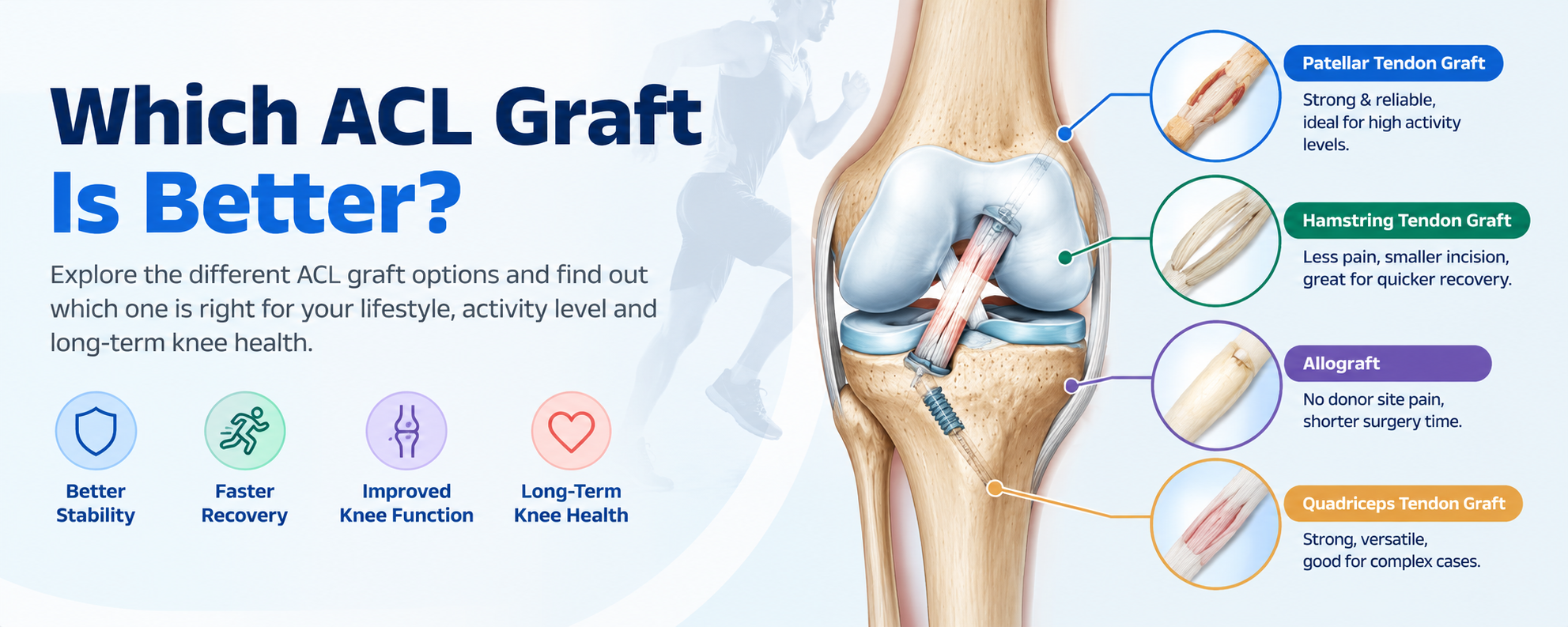
No ACL graft is universally better. Patellar tendon, hamstring, quadriceps tendon, and allograft each suit different patients, and the best choice is made after an individual assessment.
Large studies and registries compare grafts, and results often differ by population. What studies show is that grafts differ in what they cost the patient: donor-site pain, strength changes, or re-injury risk in some groups. Here is a quick look at each option.
Patellar tendon autograft
The middle third of your patellar tendon, with a small piece of bone at each end, is used. Bone-to-bone healing is a strength of this graft.
- Advantages: Secure fixation, good stability, and a long track record, particularly in active patients
- Disadvantages: More front-of-knee pain, kneeling discomfort, and a small risk of patella fracture
- Considerations: Often considered for athletes in pivoting sports, though surgeon preference varies
Hamstring tendon autograft
Tendons from the back of the thigh are folded into a multi-strand graft.
- Advantages: Smaller incisions, less front-of-knee pain, and less kneeling discomfort
- Disadvantages: Temporary hamstring weakness, and healing is tendon-to-bone, which can take longer to mature. Some studies link a thinner graft (under about 8 mm) with higher failure risk.
- Considerations: A common choice for recreational athletes and many adults, depending on graft size
Quadriceps tendon autograft
A strip of tendon from the front of the thigh, with or without a small bone block, is used.
- Advantages: A thick, strong graft with generally less front-of-knee pain than patellar tendon
- Disadvantages: Temporary thigh weakness or soreness, and less long-term data than the older options
- Considerations: Increasingly used for primary and revision surgeries
Allograft
Donor tissue, usually from a tissue bank, is used.
- Advantages: No donor-site pain and sometimes shorter surgery
- Disadvantages: Higher failure rates have been reported in young, active patients, with slower incorporation and a very small risk of disease transmission
- Considerations: Often considered for older or lower-demand patients, multi-ligament injuries, or some revisions, if available
Some centers also use other autografts, such as the peroneus longus tendon. Your surgeon will tell you which options they use and why.
Patellar Tendon Graft vs Hamstring Graft
Patellar tendon grafts are often associated with slightly greater stability but more front-of-knee and kneeling pain, while hamstring grafts cause less front-of-knee pain but may involve hamstring weakness.
Factor | Patellar Tendon Graft | Hamstring Graft |
Stability | Often slightly better in comparison studies | Good, though some studies report slightly more looseness |
Graft strength | Strong; bone-to-bone fixation | Strong when the graft is adequately thick |
Return to sports | Widely used by athletes | Widely used; depends on graft and rehabilitation |
Recovery | Early range of motion and quadriceps recovery can be harder | Less front-knee pain early; hamstring strength needs rebuilding |
Anterior knee pain | More common | Less common |
Kneeling discomfort | More common | Less common |
Hamstring weakness | Not applicable | More common, especially in deep bending |
Risk of re-injury | Some registry data show lower revision rates than hamstring in certain groups | Some data show higher revision rates in younger patients |
Patient suitability | Often considered for high-demand athletes who do not kneel often | Often considered for those who kneel often or prefer less front-knee pain |
Neither is “better” in every case. A patient who kneels for prayer or work may prefer a hamstring graft, while a young pivoting-sport athlete may be steered toward a patellar or quadriceps graft. Always discuss your priorities with your surgeon.
Quadriceps Tendon Graft: Is It a Good Option?
A quadriceps tendon graft is a good option for many patients and is increasingly used, but it is not the right choice for everyone.
What it is: A strip of the quadriceps tendon, just above the kneecap, is harvested, sometimes with a small bone block.
Potential advantages:
- A thick, strong graft
- Generally less front-of-knee pain and kneeling discomfort than patellar tendon grafts
- Useful in revision surgery or when other grafts aren’t suitable
Potential disadvantages:
- Thigh soreness or temporary quadriceps weakness
- Surgeon experience matters because the harvest technique differs
- Less long-term data compared with the older options, though evidence is growing
Who may be considered: Active patients, revision cases, and those wanting an alternative to patellar and hamstring grafts.
Compared with the others: It sits between the two in many ways. It offers a larger graft than hamstring and less donor-site pain than patellar tendon.
What Is an Allograft?
An allograft is ACL graft tissue from a screened human donor, usually obtained through a tissue bank.
Where it comes from: Tissue is donated, tested, processed, and stored before use.
Potential benefits:
- No harvesting from your own leg, so less donor-site pain
- Shorter surgical time in some cases
- Useful when several ligaments need repair
Potential limitations:
- Several studies report higher failure rates in younger, highly active patients
- Healing into bone can be slower
- Processing and sterilization may affect graft properties
- Availability and cost vary
- A very small risk of disease transmission despite strict screening
For these reasons, allografts are often not the first choice for young or highly active patients. They can be a reasonable option for some older, less active, or complex cases. Suitability varies by patient.
Factors That Determine the Best ACL Graft
Doctors weigh several factors together; no single factor decides the graft.
- Age: Younger patients face higher re-injury risk, which influences graft choice
- Activity level: Recreational, competitive, or occupational demands
- Competitive sports participation: Higher demands may favor certain autografts
- Type of sport: Pivoting and contact sports differ from running or swimming
- Occupation: Jobs involving kneeling, squatting, or heavy lifting
- Previous knee surgery: Prior harvest sites may limit options
- Knee anatomy: Bone size, alignment, and tendon size
- Ligament and meniscus injuries: Multi-ligament or meniscus damage may change the plan
- Bone health: Affects fixation
- Previous graft failure: Often calls for specialized planning
- Recovery expectations: How quickly you need to resume work or sport
- Patient preferences: Including kneeling, scarring, and donor-site concerns
- Surgeon experience: Surgeons do best with grafts they use often
ACL Graft Comparison Table
Graft Type | Main Advantages | Possible Disadvantages | Common Considerations |
Patellar tendon autograft | Bone-to-bone healing; good stability; long track record | Front-of-knee and kneeling pain; small risk of patella fracture | Often considered for high-demand athletes; less suited if kneeling is frequent |
Hamstring autograft | Smaller incisions; less front-of-knee pain | Hamstring weakness; thin grafts may fail more often in some studies | Common for recreational athletes and adults; graft size matters |
Quadriceps tendon autograft | Thick graft; less front-of-knee pain than patellar | Thigh soreness; less long-term data | Used for primary and revision surgery |
Allograft | No donor-site pain; shorter surgery | Higher failure risk in young, active patients; slower healing; availability | Often considered for older or lower-demand patients or complex injuries |
Which ACL Graft Is Best for Athletes?
There is no single best graft for athletes. Return to sport depends on rehabilitation, strength, movement control, and psychological readiness as much as the graft.
General points by sport:
- Football, basketball, and other pivoting sports: These carry high re-injury risk, so surgeons often discuss stronger autografts and careful rehabilitation planning
- Cricket: Fast bowling, sprinting, and fielding put varied stresses on the knee, so the choice depends on role and position
- Badminton and tennis: Lunging, quick direction changes, and deep knee bending make graft and rehabilitation choices important
- Running: Less cutting but repetitive load; hamstring and quadriceps strength both matter
- Gym and fitness: Squatting and lifting are common, so long-term strength and donor-site recovery matter
- Other pivoting sports: Kabaddi, volleyball, and martial arts need similar planning
Return-to-sport decisions should rely on strength, hop and movement testing, psychological readiness, and medical assessment, not graft choice alone.
Which ACL Graft Is Better for Young Patients?
For young, active patients, surgeons often favor autografts, but the specific choice is individual.
Younger athletes face the highest risk of re-injury, so surgeons usually avoid allografts in this group and discuss patellar tendon, hamstring (with adequate graft size), or quadriceps tendon options. Growth plates matter in children and teenagers, and special techniques may be used.
Rehabilitation quality and a patient-specific return-to-sport plan matter as much as the graft. No recommendation fits every young patient.
Which ACL Graft Is Better for Older Adults?
For older adults, graft choice depends more on activity level, lifestyle, and knee condition than on age alone.
An active 50-year-old who plays sports may be treated much like a younger recreational athlete. A less active patient may do well with a hamstring graft or, in some cases, an allograft, which avoids a donor site. Surgeons also check for arthritis, meniscus damage, and bone health. In some older patients with low demands, non-surgical care may be reasonable.
Treatment goals, such as walking comfortably, returning to sport, or stabilizing the knee for work, guide the plan.
ACL Reconstruction: What Happens During Surgery?
ACL reconstruction is usually done arthroscopically, through small incisions using a camera. The general steps are:
- Pre-surgery assessment: Examination, medical history, and fitness for anesthesia
- Imaging and diagnosis: MRI and X-rays confirm the tear and show meniscus or cartilage damage
- Graft selection: Your surgeon discusses options and confirms the plan
- Arthroscopic ACL reconstruction: The torn ligament is cleared, tunnels are prepared, and the graft is placed
- Graft fixation: The graft is secured with screws, buttons, or other fixation devices
- Post-operative rehabilitation: Physiotherapy starts early, often within days
The procedure usually takes one to two hours, though timing varies. Surgery is planned and performed by a qualified surgeon, and it is never something to attempt or manage without professional care.
ACL Reconstruction Recovery and Rehabilitation
Recovery after ACL reconstruction is gradual, and many surgeons advise returning to pivoting sports no sooner than about nine months, depending on testing. Timelines vary between individuals.
- Early rehabilitation: Protecting the graft, regaining knee extension, and activating the thigh muscles
- Swelling and pain management: Ice, elevation, medicines as prescribed, and gentle movement
- Range-of-motion exercises: Restoring full straightening and bending
- Strength training: Rebuilding quadriceps, hamstrings, hips, and calves
- Balance and stability: Training control of the knee
- Progressive functional training: Walking, stairs, squats, and then jogging
- Return-to-running assessment: Usually after adequate strength and control are shown
- Return-to-sport testing: Strength, hop tests, movement quality, and confidence checked before returning
For rehabilitation support, see our physiotherapy and rehabilitation page. Follow your surgeon’s and physiotherapist’s plan closely.
ACL Graft Failure and Re-Injury Risk
ACL graft failure and re-injury can happen, and the risk is higher in young athletes who return to pivoting sport.
A meta-analysis in The American Journal of Sports Medicine found that athletes younger than 25 who return to sport had a secondary ACL injury rate of 23%, meaning the reconstructed knee or the other knee. A separate study of return-to-sport decisions reported that each month of delay in return, up to nine months after surgery, was linked with about 51% lower re-injury rates. nihraleighortho
Reasons for failure or re-injury include:
- Returning to sport too early
- Weak thigh or hip muscles
- Poor landing or cutting mechanics
- Not completing rehabilitation
- New injury or accident
- Surgical or graft-related factors, such as graft size or tunnel position
Strength, proper return-to-sport testing, movement training, and following medical advice help lower risk. They cannot remove it. These figures describe groups of patients and not any one person.
ACL Reconstruction in Hyderabad
Choosing an experienced orthopedic team in Hyderabad matters because ACL care involves accurate diagnosis, the right graft, skilled surgery, and structured rehabilitation.
Patients across Hyderabad, including Boduppal, Uppal, Peerzadiguda, and Medipally, often search for ACL surgery in Hyderabad and want care close to home. Proximity makes follow-up visits and physiotherapy easier, which matters for months of rehabilitation.
When comparing an orthopedic hospital in Hyderabad, consider the surgeon’s experience with ACL reconstruction, the grafts the team uses, available imaging, anesthesia and operation theatre standards, rehabilitation support, and how openly the team explains options and costs.
Patients seeking ACL treatment in Hyderabad can consult the orthopedic team at KK Swara Hospital Boduppal for evaluation of knee injuries. Learn more about orthopedic care and sports injury treatment.
Why Choose KK Swara Hospital Boduppal for ACL Care?
Good ACL care follows a clear sequence, and each step matters. At KK Swara Hospital Boduppal, patients can expect an approach built around:
- Orthopedic evaluation: examination of the knee and review of symptoms and goals
- Proper diagnosis: imaging and assessment of ACL, meniscus, and cartilage
- Individualized treatment planning: discussing surgical and non-surgical options and graft choice
- Surgical expertise: surgery planned and performed by the orthopedic team
- Rehabilitation guidance: physiotherapy plans for recovery
- Follow-up care: reviews to monitor healing and progress
Every knee is different, and no hospital can promise a specific outcome. (Verify each service against the hospital’s official information, and add confirmed surgeon details and facilities before publishing.)
You can meet our orthopedic doctors or book a consultation.
ACL Graft Selection: Quick Decision Guide
This table is educational and is not a substitute for a doctor’s recommendation.
Patient Situation | Graft Consideration |
Young athlete | Discuss suitable autograft options with an orthopedic specialist |
Recreational athlete | Individualized graft selection |
High-impact/pivoting sports | Careful graft selection and rehabilitation planning |
Previous ACL reconstruction | Specialized evaluation required |
Older active adult | Consider activity level and knee condition |
Multiple knee injuries | Comprehensive orthopedic assessment |
Questions to Ask Your Orthopedic Surgeon Before ACL Surgery
- Which ACL graft do you recommend for me?
- Why is this graft suitable for my age and activity level?
- What are the advantages and disadvantages?
- What are the risks?
- How long could rehabilitation take?
- When can I return to work?
- When can I return to sports?
- What happens if the graft fails?
- Will I need additional procedures for meniscus or cartilage injuries?
Evidence and Statistics at a Glance
- Re-injury (research finding): In the meta-analysis above, younger patients under 25 had a 21% secondary ACL injury rate, and athletes who returned to sport had 20%. nih
- Return to sport (research finding): Ardern and colleagues’ 2014 BJSM review reported that about 81% of patients return to some sport, about 65% to their pre-injury level, and about 55% to competitive sport. Verify before publishing.
- Decision rules (research finding): A Delaware-Oslo cohort study found that simple return-to-sport decision rules were linked with an 84% lower re-injury risk. raleighortho
- Graft comparisons (general evidence): Reviews generally find patellar tendon grafts linked with more kneeling pain and hamstring grafts with hamstring weakness. Differences in overall function are often small.
- India: Reliable national ACL statistics are limited, so this article does not quote any.
- Individual factors: Final graft choice depends on clinical assessment and cannot be decided by statistics alone.
FAQ Section
- Which ACL graft is better?
No single ACL graft is better for everyone. Patellar tendon, hamstring, quadriceps tendon, and allograft each have strengths and trade-offs. The best choice depends on your age, activity, knee condition, and your surgeon’s assessment. - Which is better, patellar tendon or hamstring graft?
Patellar tendon grafts are often linked with slightly better stability but more front-of-knee and kneeling pain. Hamstring grafts cause less front-knee pain but may weaken hamstrings. Neither is better for every patient. - Is a quadriceps tendon graft better than a hamstring graft?
A quadriceps tendon graft is usually thicker and may offer strong outcomes, but it can cause thigh soreness. Which is better depends on your activity, anatomy, and surgeon experience. - Is an ACL allograft better than an autograft?
Not usually for young, active patients, as several studies report higher failure rates with allografts. Allografts may suit some older or lower-demand patients or complex injuries. - Which ACL graft is best for athletes?
Surgeons often consider autografts for athletes, but the best option depends on the sport, position, and individual factors. Rehabilitation and return-to-sport testing matter as much as the graft. - Which ACL graft has the fastest recovery?
No graft guarantees a faster recovery. Hamstring grafts often cause less early front-knee pain, but full recovery depends on rehabilitation, strength, and individual healing. - Which ACL graft has the lowest risk of failure?
No graft has the lowest risk for everyone. Failure risk is also influenced by age, sport, graft size, rehabilitation, and return-to-sport timing. Allografts show higher failure rates in young active patients in several studies. - How long does ACL graft recovery take?
Many people walk comfortably within weeks, but return to pivoting sport usually takes around nine months or longer. Timelines vary with the graft, rehabilitation, and progress. - Can I return to sports after ACL reconstruction?
Many people do, but results vary. Return depends on strength, movement control, confidence, and medical clearance. Research shows that returning too early raises re-injury risk. - How do I choose the right ACL graft?
Discuss your age, sport, occupation, knee condition, and preferences with an experienced orthopedic surgeon. Ask why a graft suits you and what the trade-offs are.
Key Takeaways
- No universal winner: There is no single best ACL graft; patellar tendon, hamstring, quadriceps tendon, and allograft each suit different patients.
- Trade-offs differ: Patellar grafts bring more kneeling pain, hamstring grafts may weaken the hamstrings, quadriceps grafts can cause thigh soreness, and allografts carry higher failure risk in young athletes.
- Personal factors decide: Age, sport, occupation, knee condition, previous surgery, and goals guide graft choice.
- Rehabilitation matters: Strength, movement control, and well-timed return-to-sport testing influence outcomes as much as the graft.
- See a specialist: An experienced orthopedic evaluation gives personalized advice that online comparisons cannot.
Conclusion
So, which ACL graft is better? There is no universally superior graft. Patellar tendon, hamstring, quadriceps tendon, and allograft options each offer different strengths, and the right choice depends on your age, activity level, sport, occupation, knee condition, and goals. Rehabilitation, strength, and careful return-to-sport decisions matter just as much as the graft itself.
If you have a knee injury or are considering ACL reconstruction, a personal evaluation will give you clearer answers than any online comparison. Patients in Hyderabad and nearby areas can seek an orthopedic evaluation at KK Swara Hospital Boduppal to discuss their options and plan treatment with an experienced team.
This article is for general awareness only and is not a substitute for professional medical advice. Please consult a specialist at KK Swara Super Speciality Hospital for diagnosis and treatment.